By Lizzie Bisley, Curator of Modern Art at Te Papa Tongarewa
Art, to me, is about communicating something – either something that can be articulated or something that can’t … And that’s what I try to do. I either try and transform people’s views of things so that they’re seeing things in another way, or else I’m trying to comment on something, perhaps on a more intellectual level rather than just on a feeling level, maybe both.
(Christine Hellyar, quoted in ‘Christine Hellyar, Drawings and Books’, Manawatu Art Gallery, 1986)
The Auckland artist Christine Hellyar – who sadly passed away earlier this month – built a ground-breaking sculptural practice, and was influential as a teacher at Elam School of Art. Her work is held in collections around the motu from Tāmaki Paenga Hira | Auckland Museum to the Dowse.
Born in New Plymouth in 1947, Hellyar spent her childhood in Taranaki before moving to Auckland in the 1960s to study at Elam in Auckland. There she began working as a sculptor, initially experimenting with casting, including casting in latex. The work Aluminium skin, in Te Papa’s collection, was done while she was a student.


From the 1960s onwards, Hellyar’s work was shaped by a deep fascination with materials, process and found objects. Her sculptures were often connected to the human body, and they frequently explore the relationships between people and the natural environment. In one of her major early works, Country Clothesline (1972, Govett-Brewster Art Gallery collection), twenty–two items of clothing were dipped in latex and hung on a rope propped up with a wooden pole. The sculpture’s stiff latex clothes evoke the weather and the landscape, but also the body, and the rhythms of domestic work.
In the 1980s and 1990s Hellyar produced a series of works in which made and found objects were gathered in cabinets, cupboards, boxes or jars. These objects were often ordered by type, arranged into categories. At the same time, they slip their seemingly scientific order – endlessly disrupted by the domestic furniture that houses them, by the translation involved in processes like casting, and by the material invitation to touch and imagine, rather than just look and record. The objects in these collections speak to forms of knowledge that sit outside the bounds of science or museum classification, breaking down hierarchies of thought, and connecting Hellyar’s practice with that of other contemporary feminists.
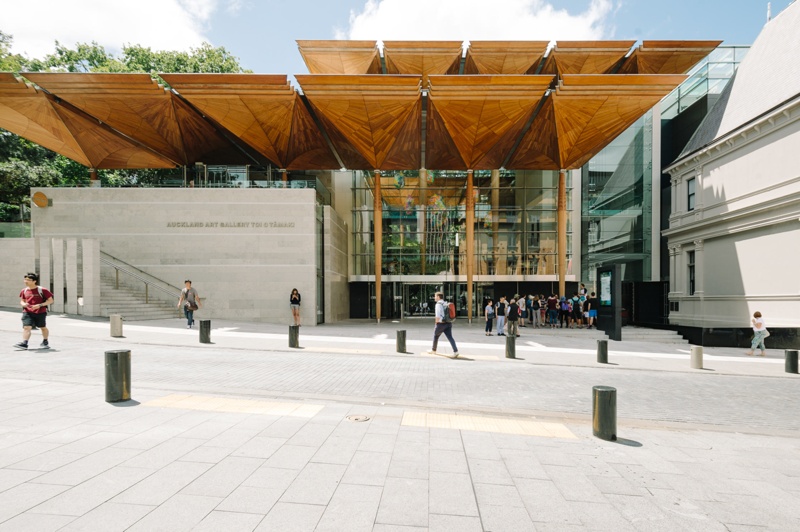
Hellyar always used drawing and words in her work. Her drawings were often related to her sculptures, as with this delicate ink drawing in the Auckland Art Gallery Toi o Tāmaki collection. Here floating shapes billow in the top half of the page, conjuring the many forms of human and animal shelter that Hellyar stitched, wove, plaited and molded for her 1982 artist project at the gallery, titled ‘Shelter’.


Like shelter, clothing is an idea and a category that Hellyar returned to often. She made multiple series’ of artworks using aprons, with the aprons sometimes holding other objects. In 1988 Hellyar described aprons as objects that are: ‘used on the body to protect the body & collect things that are everyday, mundane, useful and little to do with violent powers’ [1]. As in so much of her work, aprons are offered up as quiet, but powerfully resonant objects.
Christine Hellyar practiced as an artist for over 50 years, and in that time she produced a remarkable body of work. Her sculptures, drawings, artist books and writing remain endlessly beguiling and provoking – in their forms and materials, but also as prompts to a different way looking at and thinking about the world.
[1] Quoted in Marian Evans, Bridie Lonie and Tilly Lloyd (eds), A women’s picture book (Wellington, 1988), p. 129.